


Steve was aware of the people’s eyes on him as he passed. They stood on the verandas of the little shops with peeling paint and pretended to be engrossed in their chitchat but he could feel the piercing gaze of their eyes like so many fires on his body. But he did not care; by God he did not give a hoot. They could stare till Thy Kingdom Come, the hypocrites! He kept his eyes on the uneven path by the shoulder of the tarmac road on which he had plied for years as a matatu driver. Matatus flew past in both directions going to Murang’a or going to Kangema.
” Wakini, age—mate!”
The salute drew Steve’s attention. “Oh, yes age-mate!” he said, knowing that must be Kanja, his friend since boyhood.
“How are you, Son of my Mother?” Kanja asked.
As he always did these days, Steve scanned his friend’s eyes for any hint of mischief. Kanja’s inquiry seemed genuine enough and Steve was glad he could count at least on one real friend. One real friend — he marveled at the thought. From a struggling open-air mechanic with hardly any friends to a successful entrepreneur running a chain of matatus trying to jostle between the demands of family, business and crowds of friends. He had come down to this: one genuine friend.
How the world shrinks!
“I am OK — or so I tell myself,” Steve said.
“And how is the One-We-Never-Call-By-Her-Name?
You remember the song, brother?”
Steve started to sing:
My mother I will never call her by name
I will never insult her I will call her the seer who saw for me My second God!
“She is as fine as can be, given the years,” Steve enthused. The two men fell in step. Above them the noon sun rode high, casting their stunted shadows at their feet. The last block of shops stood out. It was a one-storey building and newly painted. “You must have heard I bought this building,” Steve said. “Yes, I’ve heard many other things besides,” Kanja replied. “I am sure of that,” Steve said turning the key and throwing the door open. “In this village, nothing passes unspoken. People just can’t mind their own business.” There was a tinge of anger in his voice.
“Come in age-mate and tell me just what you’ve heard.” They sat behind the counter. “So what have you heard?” he demanded almost immediately. Kanja had actually expected to discuss the rumours that were going around the village about his friend. After many days of soul searching, he had decided to approach and coax Steve into telling him with his own mouth what he was up to. That is what age-mates were for but he had not expected his friend to be so forthcoming. He was caught off— guard. Still, he quickly composed himself and said: “I hear you plan on marrying Maureen.
“Marry?” Steve spats. After a while he went on: “Well, maybe someday. In truth, Steve had asked Maureen to marry him. At first, she had refused saying she was too old for him and she had baggage from her first marriage. But after Steve had assured her he was ready to love her and her children as if they were his own blood, she had gradually begun to think it possible. Then she learnt she had the virus that causes AIDS and said this could never be. Steve had been deeply hurt. Still, he vowed he would never abandon her.
They would beat this thing together. But he could not explain all this to Kanja. What did it matter, anyway?
“Then what is going on between the two of you?’ “Ask the ones who told you I am marrying.
“I want to hear from you,” Kanja declared.
“Are you sure you want to hear?”
“1 would not have asked.”
“Well,” Steve stared at the ceiling for a while, “you know me better than most. Ever since we came of age, life has just been one long struggle. Family; business, friends. All drudgery and what do you get in return? It is Maureen who lit the sun in my life and made me realise that all this is vanity. Like chasing after the wind . . . She’s my friend,” Steve ‘asserted almost defiantly.
“Just that? I also hear you are the father of her son,” Kanja persisted. “Tragedy is when children are made by people who are not friends,” Steve asserted. “So it is true?”
“What?”
“You are the father?”
“Ask me another.”
For a while, an awkward silence hung between the two men, threatening to cloud the light of friendship.
“I don’t blame you. Maureen is sure a smashing beauty,” Kanja smiled to break the clouds. “I don’t know what you mean. I used to think so too but what is beauty? Just a good figure? But I ask again. What is beauty?” The silence fell again. Then Steve went on: “I will tell you. Beauty is the promise of happiness. For so long, I was unhappy. Then one morning at sunrise, I remember the day all too well, I met Maureen. She was new in this village. I was driving to Murang’a and she sat in front with me. We did not talk much but something passed between us. That promise — the promise of happiness. It was there in her generous smile, her bellyful of open and cascading laughter. Later in Murang’a town as I waited for my matatu to fill, we had a cup of tea and talked a little. She had been married by a soldier who was always accusing her of unfaithfulness, though she knew for sure he kept a mistress. Sometimes when he came home, he would batter and leave her for dead for smiling and laughing with men, he said. Still not wanting to break her family, she held onto her marriage and prayed that God would stop her husband’s wayward ways. One day, the man came home ill. The doctor said it was pneumonia. The drugs didn’t seem to work and the man was reluctant to seek further treatment. Then he closed his eyes and willed himself dead. When they tried to wake him up, he was dead. Just like that — a very unsoldierly way to die if you ask me, It was a long and touching story of a woman’s love and commitment that seemed to fill an emptiness that I had not even suspected existed in my soul. I could have traded my matatus for just that one cup of tea with that woman — I swear, age—mate!” “I am afraid you’ve done so already,” Kanja said cautiously.
“I said it is a long story. But it is also a simple story no matter what riveting turns and you — I mean people here, try to give it. But I maintain you do not yet live until you reserve the right to make your own story. It is not family, money, or even friends who will tell your story. Even if you died, your family and friends can only tell the story you made for yourself and, age-mate, you don’t make a story worth telling unless you truly lived!” A wan smile played on Steve’s lips as if daring his friend to contradict his assertions.
“I see,” Kanja said meaninglessly.
“You’ve seen nothing yet. Cowards do not make stories and you, my friend, are a great one,” Steve charged. “Want to know why I say that?” Kanja shook his head affirmatively.
“Be-because here you are,” Steve’s voice was laden with emotion, “an old good friend going on about things you’ve heard, about me, mind you, and not having the guts to speak the one main thing that you’ve heard — because nobody knows you all suspect and then create stories and pass them around. But nobody knows for sure. Yet you do not have the courage to ask me: agemate, is it true that your friend Maureen, has AIDS? Instead, you sit here and like all god —forsaken hypocrites go on about what a smashing beauty Maureen leave is and you, like all the other frauds in this village, have absolutely no idea what beauty is all about. Tragedy is friendship that wears the rayed cloak of hypocrisy! That’s how they hanged Jesus, you know. I am no man Christ though, but you can crucify me if you want. I do not give a didn’t hoot one way or the other.” “I’m sorry brother, I actually meant to ask,” Kanja said to apologetically.
“OK, brother. Ask. I’m afraid I lost my cool,” Steve threw the gauntlet.
“So is it true?”
“Why are you afraid of speaking the word?” Steve smiled. “And is it not a four- letter word anyway? So why are you afraid?”
“OK, age-mate. So is it true Maureen has AIDS?”
“That is good. You will be surprised that when we put names give to our fears, they are not as threatening as they appeared at first.
Besides, it is not like you’ve anything to fear yourself. The last time I who knew, you were a hallelujah, drum-beating Christian in the House of 1 only Miracle Tabernacle. AIDS is not for the heaven-bound, you know.” make The sarcasm hit Kanja like a blow, making him grimace. . ..but here d on we go: yes it is true. Maureen has AIDS,” Steve affirmed.
Oh! Kanja thought almost audibly. He remembered the first day he met Maureen and how enamoured he had been of her you, easy-going manner. She had politely turned down his advances. Hurt, Kanja had avoided her and hoped she would keep her mouth shut. But now he saw the hand of God in what had happened. He visualised himself carrying the virus in his body and people talking behind his back and shuddered. Steve was right. He, Kanja, was a me, coward. He would rather hang himself than have the whole village that back-biting him. He looked at his friend. Did Steve also have the then big disease with a small name? All this time, Steve held Kanja’s eyes in his gaze, a bemused expression on his face. He thinks that God loves him more because he is not ill. But how he even knows, the fool, Steve thought. He smiled wanly and said, “So now you know, from the horse’s own mouth, as they say. Spread the gospel.”
“Thank you for confiding in me. I appreciate,” Kanja said.
“I’m not confiding. Please pass on the word. I am tired of all the rumours and ignorant innuendos. Can I count on you seeing that you are a good, old friend?”
Kanja hesitated, unsure of what to say. Suddenly, Steve rose up. “Come with me,” he said leading the way through the back door. They went down a flight of stairs. Walking past rooms that opened on a long veranda, Steve pushed open a door at the far end of the compound. “After you, agemate,” he said ushering his friend into a suite of immaculately kept rooms. Kanja sat on the sofa and savoured the ambience while Steve went into one of the rooms. He came back accompanied by Maureen, her three-year-old son in tow, tugging at her skirt. The smile was still there but the woman looked somewhat weary. The little boy went and sat on his father’s lap. “Maureen, I wanted you to meet one of my old, boyhood friends. Kanja and I ate the knife on the same day on the banks of River Mukungai,” Steve said sitting beside his friend. “Oh, Mr. Kanja. I know him but I didn’t know that bit about the knife,” Maureen beamed.
“You know him?” Steve asked.
“Of course.Kanja is among the first people I got to know when I came to this market. In fact, we could have been friends. Unfortunately, he wanted discretion. And I did not want to live in the shadows.”
“I didn’t know that bit either!” Steve exclaimed and started laughing. “In the shadows . . .,” he said between bursts of mirth. “In the shadows,” he repeated, savouring the words as if they held the key to the complexities of life. “So many of us are used to the shadows that when you dare to stand in the light of day, people behave as if you’re the one in the wrong!” he said.
Maureen stole a glance at Kanja. The poor man was fidgeting and sweating. She rose and opened the window. She served several glasses of fruit juice and passed them round. Kanja held the glass cautiously, his fingers shaking like an alcoholic’s. “Welcome Kanja. It is great to have you visit,” she said. “Kanja has no idea how good it was for him to come. When you are suffering from AIDS, one good friend is all you need to make life less suffocating. A person is only a person through other persons, Steve observed. “You too? Suffering from AIDS?” Kanja breathed the one question he had been afraid to ask. He sounded perplexed.
Steve smiled vaguely. But before he could speak, Maureen weighed in. The story, she seemed to suggest, was hers to tell. “I remember I had gone for a routine prenatal check when the doctor broke the news. When I was diagnosed with AIDS, I had only one prayer. In that moment when the sun seemed to set on my life, I prayed that my unborn child be free of the virus. I prayed that somehow Steve would be free of the virus too. Oh, how intently I prayed. When my son was born and he turned out negative, my night suddenly went ablaze with a thousand stars. But there was one problem. Steve would not take the test. When he finally acquiesced, he was positive. I was devastated. My stars waned . . .
Steve knew the signs all too well. The clouds were gathering and soon there would be a storm, a deluge, he knew. He did not like the way she spoke. Her earnestness sounded almost unnatural. And why must she try to sanitise him?
“I have forbidden you to blame yourself for anything!” Steve growled. “Oh, you don’t know how it feels seeing you suffer and knowing that I brought this pestilence on you. But I swear I have been a faithful woman. I
was faithful to my husband. I was faithful to you, Steve . . .,” her voice broke and she burst into tears.
“Listen Maureen,” Steve spoke with a tenderness that surprised
Kanja. A strange light played in his eyes. “Never cry when the sun goes down for if you do, the tears will not let you see the stars,” he pleaded.
She heaved and gasped painfully, trying to get hold of her emotions. Finally, she wiped her tears and looked at her son, playing innocently on his father’s lap. She had two daughters from her first marriage but this boy, the fruit of the only true love she had ever known in her thirty and five years under the sun, was the crown of her life. Still, a fear tugged at her heart leaving her belly feeling an airy hollowness. Would she live to see him grow up into a man? And if she died, would Steve care for him or would he let the boy to wander unloved, unwanted on the harsh streets of life? Maureen had no doubt that Steve would live: he had the will. She wished she too could summon up that kind of spirit. She looked at Steve and their son again, the way a seer peers at the contents of his diviner-gourd to read the secrets of life and she smiled wearily These were her men. She could die but these two, father and son, would always be together. Nothing could separate them. She could see that in the way the boy sat and played so snugly with his father, in the way Steve held him as if he would never let go. It was such a perfect picture. Just as if the whole world was just the two of them. Still, she wanted reassurance but when she tried to speak, the-words would not form. Steve held her eyes in his in that judicious manner of his and she knew he knew what she wanted to ask. And the answer was in his eyes — a more profound answer than any words could speak. In that moment, Maureen felt strangely relaxed and her heart sang: Ngûmbûkanyumethîî, Mageganiameekwothîî, matarîmekwo! Yes, she would fly out of this world and wonders hitherto unseen would be performed on earth …
Maureen felt ready to fly.
Witnessing all this, Kanja felt like a fraud, like a sneak and an eavesdropper — desecrating something sacred, He had not touched his juice yet. The glass, nay the cup of suffering, was still there on the table where he had put it. He kept glancing at it as if the HIV virus was a genie he expected to any moment emerge from the glass and strangle him to death. He wished for a miracle that could remove the glass before him.
“I want more juice,” the little boy said.
Steve took Kanja’s glass, drank half the contents and then holding the glass to the boy’s lips let him drink the rest of the juice. The boy smacked his lips contentedly.
“It is getting late,” Kanja said, feeling very small. “I’ve got to get going.
“I will see you off,” Steve said.
The boy would not agree to be left behind. Steve held his hand and together they walked Kanja out. Together as one, Maureen thought watching father and son walk out. A perfect picture: let the maddening crowds take it, frame it, and look at it from all dimensions. Yes, let them bring one better, cleaner, holier picture from the darkly shadows in which they lived! Long after Steve and the boy had left, Maureen stood in the middle of the room gazing at that picture in her mind. The beauty of it tugged painfully at her heart and in spite of herself something gave way. Warm tears flowed freely down her face. If only people were more compassionate.
The sun was already dipping behind the Kianderi hills. “How time flies!” Steve exclaimed when they came to the road. “Let’s see you again when the sun rises. “Yes, let’s,” Kanja said.
When he returned, Steve found Maureen coiled up in bed; a picture of dejection. Her Bible, everpresent these days, open at Psalms Twenty-Three. “What is it, Ma?” the little boy asked. He tried to turn her over but Maureen buried her face in the pillows and wept.
The boy started to cry. Maureen sat up and took him in her arms. “You know why your friend did not drink the juice?” she asked between her heartwrenching cries.
“Yes, of course I know,” Steve replied.
“Why are people so cruel?”
“No, Maureen. Normally, people do not mean to be cruel. Most are just selfish and ignorant. It is normal, I think, to fear the unknown.
“It hurts . . . when your age-mate comes to my house and refuses to take what I serve him, it hurts,” Maureen moaned.
“You must learn to ignore people like that. What they say, what they do. What does it matter? Are they not the same people who a while ago used to speak of how beautiful you are?
“They didn’t mean it!” Maureen scowled like an angry cat.
“Of course, they didn’t. Gûthekiotikwendwo, to be smiled at is not to be loved. That’s how the elders caution us. But do we listen? No! The result? I will tell you. Dysfunctional, loveless families that weigh like a millstone around our necks or we are condemned to living shadowy, demeaning lives that turn the best among us into mean and cruel monsters. I don’t consider that living. And verily, verily I say unto you: do not be deceived. Despite all the pretences, not many people can say they have lived as happily as we have lived these past three or so years. That is something. That is everything. And we can still live if you always remember to forget the things that make you sad, and remember to remember the things that make you glad. Like our son,
here. Let’s always count our blessings, dear.’
“You should have been a preacher,” Maureen smiled.
Steve felt a strong craving for a cigarette. His lips and fingers quivered. He looked longingly at the three cigarettes he had stringed together and hung at the head of his bed the day the doctor asked him to stop smoking. For a while, he struggled with the temptation to reach out for one. “Actually, when I was young I toyed with the idea of becoming a Catholic priest. My mother discouraged me. I was her eldest child, you see, and when my father passed on, I knew I had a duty to my ancestors to keep the family name alive. That’s why for me it is such a good thing that Kimotho is free of the virus. When we are gone, he shall bring us back you and me to earth through his own children. Do you realise that in the next generation, we two shall be brother and sister?” Maureen now laughed. This man, the things he spoke. “But you don’t know whether he shall have only sons or only daughters, or even no children at all,” she said.
“I am positive…”
“Of course, you are. The doctor said so,” she interjected.
Steve laughed. He felt good. If she could joke about their status, that was a good sign. There was hope. “It is not of that I speak. That I accept. What I meant to say is that I am sure our son shall have a son of his own, who as is customary, he shall name after his father; and a daughter whom he shall name after his mother. In our next life we shall be brother and sister! Don’t you see Maureen, today we may have no names in the street. For those who know no better, the virus might be our first names but our names, our remembrance shall never be erased from the face of the earth!”
It was true, Maureen thought. The cycle of life of which Steve spoke was so true. So comforting. Wasn’t she herself the reincarnation of her grandmother? Were these not the wonders to be performed when she was gone? How had she forgotten such a natural principle of life? The revelation was so uplifting. She hugged Steve. “I will always love you — in this and the next life,” she smiled and for a moment it was just like in the days when they met. “Let me tell you something. One day, I will meet your mother just to tell her what a wonderful man she managed to bring into this world. You know, women don’t bring forth boys like you anymore.”
In the corner, Steve put a record on the gramophone. In a while, Kamarû’s silky-smooth voice filled the house with wistful love lyrics “Till Death Do Us Part.” It was one of Steve’s favourite records. As he sang along, he marvelled at the power of love to overcome:
My love
I love you like a ring on the finger
Or like my bedtime clothes I love you like a mirror directed towards the sun Or like an orange in the month of dryness…
The song held Steve in its spell. And it dawned on him how true the words of the song were. The greatest is love. It was the only sanctuary for those who suffered. Yet, what a short supply it was in! He wished people would not horde love, the way businessmen hid flour so that the price could go up. Always thinking about their profits while across the country, hunger trailed the poor to their beds. What selfishness! what cruelty! God, forgive them for they know not what they do!
It was now dark. Steve stood at the window. A smattering of stars was barely visible in the sky. He switched on the lights and blinked against the sudden brightness that flooded the room. Maureen was like the sun; the way the pendulum of her moods swung these days, shining bright one moment and hiding behind dark clouds in the next. Now she lay on the bed, the little boy asleep in her arms, looking forlorn, woebegone.
Steve went to the kitchen and started preparing supper. As he fell to work, he smiled to himself with a new remembrance. According to the people, Steve’s woman had bewitched him. See how he goes shopping in the market, and I hear he even cooks for her . . .. Now 6′ what’s that if not medicine? A man cooking for a woman? That woman, she’s ruined a fine man just so that she can reach his money! Such talk used to enrage Steve. Now he just savoured it indulgently, remembering many years ago when his mother traded clay pots at the Murang’a market. He would help her sometimes. But on many a day, he would be left at home to take care of his sisters — washing for them, cooking for them. So what was the big deal? Let those who must speak because they have mouths to speak. Yes, let them talk.
The food was ready. Mweapishoriserved with kunde, lentils, spinach and fried liver. The little boy gobbled up the food happily but Maureen would not eat no matter how hard Steve tried to coax her. It was a waste of good food, seeing that she was dying anyway, she argued. “You can’t hold your health if you don’t eat,” he pleaded.
“You just must eat and take your drugs every day.
“Oh Steve, you don’t know how weary I am. I just wish to rest. Steve tried to jostle with Maureen and managed to force some food into her mouth. She gave in but after she had eaten just a few spoonfuls, she started to gasp as if she would throw up. Nausea. “l just wish to rest,” she repeated. Steve knew very well what she meant by rest. “l have told you many times that you should banish thoughts of death from your mind,” he admonished.
“Knowing that every sun that sets brings me closer to the grave?”
“But it does that for everybody.”
“Well, yes. Life is a fatal disease. But with AIDS coursing through my veins, I am the living dead already,” Maureen declared.
“That’s the wrong way to look at it and you know it,” Steve retorted with a tinge of impatience. “Why is it when we agree that we must fight this thing together, you keep on retracting? Why?” “But I am just a woman you know. The mind agrees with you but the spirit is weak,” Maureen said. “You insult yourself. You insult all womanhood. What on earth do you mean, the mind is willing but the spirit is weak?” Steve demanded. But maybe she was right, he mused, Maureen had simply allowed the virus to kill her spirit to live. On second thought, he concluded that this was not even true. This had nothing to do with the fact that she was a woman. It had nothing to do with the virus either. It had to do with her deep-seated sense of guilt. The feeling that she was somehow responsible for his illness. It was an idea that loose speaking mouths had so rooted in her unconscious mind that it was always lying somewhere just below the surface, ready to bubble up any moment at the least excuse. Like a refrain in a dirge or a stuck gramophone record, those idle words repeated themselves so regularly in her heart that she too had come to believe them. That woman, she’s ruined a fine man just so that she can reach his money! No matter how much you loved them, how did one uproot a thorny thicket that grew inside another person’s heart? Without Maureen, Steve knew that there should be no sunshine in his world but for the first time ever, he allowed himself to contemplate the terrible possibility of her death.
“I was a faithful woman . . . faithful to my husband . . . faithful to this other man, the only man who ever truly loved me and treated mc like a woman should be treated. With love.Respect. I was a faith-‘
“Maureen, are you alright?” Steve asked, roused from his sleep by her rumbling. He switched on the lights. Maureen coiled away to the far end of the bed, her back against the wall and a dazed expression on her face. She was trembling like somebody who had just woken up from a nightmare. A burst of panic sent spasms of fear cascading down Steve’s spine. Gently; he touched her brow. It was scalding hot. Was this the moment he had dreaded?
Though I walk through the valley of death . . . thy rod and thy staff … comfort me!” Though she sounded coherent, Maureen’s eyes Steve had a glassy and empty look.
Steve jumped out of bed and started to dress. His mind was in a turmoil. “Thou prepare a table before me in the presence of my enemies . . .,” Maureen mumbled on.
Steve shook her, trying to snap her out of her reverie. . my cup overflows “Maureen!
“1- I sha-lldwc-ll in the hous-e of the Lo-r-d for ever!” She was losing coherence.
“No Maureen, please! Please don’t leave me mama Kimotho,” Steve cried. He held her in his arms and felt her go limp as she lost consciousness. They say a man’s tears flow into his stomach — not to be seen. Steve felt his drip like rain drops. He stormed out of the house to where he parked his pickup truck in the corner. It had been a long while since he used it but when he turned the ignition, it started readily. He drove it up to his door. He saw a neighbour peeping through the window and gestured to him to come out. He was a young teacher at the local primary school. “Tom, Maureen is very ill.
I want to rush her to the hospital. Please help me carry her into the truck.”
“The truck cannot be comfortable if she is so ill,” Tom pointed out. “That’s true but . . ..”
“Mr Kabia’s house is just behind the shops. I will see if he can lend me his car,” Tom explained and dashed off before Steve could say anything. He came back almost immediately without the car. Steve did not ask what had transpired. They carried Maureen out and sat her in the front seat. She was limp and heavy but her pulse was okay. The hospital was only twenty minutes away and they arrived within no time. Steve explained what had happened. “She is HIV-positive and of late she has refused to take her drugs.’
“That’s dangerous,” the doctor said. He examined her for a while and had her admitted right away. As the nurses wheeled her to the ward, with Steve and Tom trotting beside them, Maureen regained her consciousness.
“Steve dear . . . What’s happening? Where are they taking me?” Then realising that she was in hospital, she screamed. “Hospital!” She spat out the word like a bitter pill. “I don’t want to die in a hospital, Steve.’
“You’re not dying, Sister,” one of the nurses said soothingly.
“I am dying . . . Why don’t you just tell me I am dying!”
Even as she protested and pleaded with Steve not to leave her in the hospital, the two nurses eased Maureen into a bed. When it was obvious nobody was paying any heed to her protestations, Maureen coiled up in bed in her familiar manner. “Steve, bring your mother to see me. I’ve an important message for her. Please do not fail.” After that, she did not speak any other word — not even to Steve.
The following morning, Steve was up early. After making breakfast and feeding the boy he left him in Tom’s house and went to the hospital. He went to the ward. One of the nurses who had attended to them the previous night was at the report desk. Was she avoiding his eyes? With a sense of trepidation, Steve glanced towards the bed in which Maureen had lain. It was empty.
‘I’m so sorry, Steve,” the nurse said. “Please come with me.” He followed her into a small office.
“She passed on at around four this morning,” she informed him. Steve was in a daze. Did pass on mean die? “How? Why?” “Pneumonia,” he heard the nurse speak from far, far away.
Opportunistic diseases, Steve thought. The doctor had warned that those were the main threats to a person living with HIV and AIDS. He felt as if his legs would give in under him. He sat down. A bout of dizziness overwhelmed him. Around him everything went dark.
They buried her within the week. A great many people turned up that Saturday for the brief ceremony. Many stood in small groups conversing in whispers. What will he do with the child now? Maybe Maureen’s daughters will take care of him. You know, a child once born is never thrown away. Throughout the ceremony, Steve stood by the grave. He could feel the hundreds of eyes drilling into him, but he did not mind. They could stare till their eyes popped out. Soon the grave was a mound with freshly planted flowers. The people retreated to the perimeters of the farm, talking, whispering and staring.
Steve started looking around. Where was Kimotho? He saw the boy leaning against a banana tree.
He walked towards him. “Boy!” he called when he was within ear shot. “Time to go home, Daddy.” The boy came running.
Steve hoisted the boy up, like a flag, and sat him spread-eagled across his shoulders. He could feel the tears dripping into his stomach but he was determined that they should never flow down his face. And in his sadness, the words he had always spoken to Maureen in her moments of depression, now spoke to him with a meaning so profound. When the sun goes down, do not cry because the tears will not let you see the stars. Maureen might be dead but she had left him with this boy, their son, to always remind him of she who once lit up his life so brightly. As Steve walked away, people cleared the way before him, and the boy waved at them. Bye!
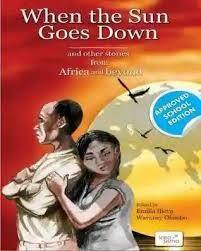
From When the Sun Goes Down by Gorowa Kamau from the anthology When the Sun Goes Down and Other Stories from Africa and Beyond. Edited by Emelia Ilieva and Waveney Olembo. Nairobi:
QUESTIONS ABOUT THE STORY
- Where is Steve when we meet him?
- What change has occurred in Steve’s life?
- In your own words, explain Steve’s understanding of beauty. How does it differ from the common understanding of beauty?
- What is Steve’s attitude towards those spreading rumours about his condition?
- Why does Steve consider Kanja a great coward?
- Why do you think the author uses Maureen to explain how Steve contracted HIV rather than let Steve himself do it?
- Explain the difference between Maureen’s and Steve’s attitude towards their HIV status.
- Does Maureen die because she is infected with HIV? If not what do you think kills her?
- Contrast Steve’s attitude towards women with that of the society in general.
- Why do you think Mr. Kabia refuse to lend his car to Steve?
- In not form, discuss how we should treat those infected with, or affected by HIV and AIDS.
- Why do you think it is important to get tested for HIV?
- Describe Tom’s characteristics. Why do you think Tom seems the only one willing to assist Steve?
Discussion questions
1.“Love is a sanctuary for those suffering from HIV and AIDS and other related illness.” In light of the events in the story and even from your own experience, discuss this statement.
2.“A person is only a person through other persons.” What does this mean in the context of the story?
3.One of the greatest challenges to HIV and AIDS is the issue of stigma. How does this affect Maureen in the story and what can we do to eliminate stigma in our society?
- Where is Steve when we meet him?
Steve is passing by on the tarmac road while walking, most likely in a village, and his friend Kanja greets him.
- What change has occurred in Steve’s life?
Steve has gone from being a struggling open-air mechanic with hardly any friends to becoming a successful entrepreneur running a chain of matatus (minibuses).
- In your own words, explain Steve’s understanding of beauty.
How does it differ from the common understanding of beauty?
Steve’s understanding of beauty is not merely physical appearance but the promise of happiness. He finds beauty in Maureen’s generous smile, open laughter, and her ability to bring happiness into his life. For him, beauty is not just about looks but about the positive impact a person can have on his life.
- What is Steve’s attitude towards those spreading rumors about his condition?
Steve seems frustrated and angry at those spreading rumors about his condition. He refers to them as hypocrites and seems unbothered by their gossip. He is willing to openly discuss his situation with his genuine friends like Kanja.
- Why does Steve consider Kanja a great coward?
Steve considers Kanja a coward because Kanja was reluctant to ask him directly about the rumors surrounding Maureen’s HIV status. Instead of having an open conversation with his friend, Kanja relied on gossip and innuendos.
- Why do you think the author uses Maureen to explain how Steve contracted HIV rather than let Steve himself do it?
Without having access to the full story, I can only speculate, but the author might have chosen to have Maureen explain how Steve contracted HIV to show her perspective and emotions regarding the situation. It may also add depth to Maureen’s character and highlight the challenges faced by those with HIV.
- Explain the difference between Maureen’s and Steve’s attitudes towards their HIV status.. Maureen seems to be more emotional and fearful about her HIV status, while Steve appears to be more accepting and pragmatic about it. Steve is ready to face the situation head-on and live with the virus, while Maureen may struggle with feelings of guilt and vulnerability.
- Does Maureen die because she is infected with HIV? If not, what do you think kills her?
- Contrast Steve’s attitude towards women with that of society in general.
Again, based on the text provided, it’s challenging to make a detailed comparison. However, if Steve values women based on their character, happiness, and the promise they bring to his life, his attitude differs from the common societal emphasis on physical beauty and superficial traits.
- Why do you think Mr. Kabia refuses to lend his car to Steve?
Without additional context, it’s challenging to provide a specific answer. Mr. Kabia might refuse to lend his car due to the rumors or gossip surrounding Steve, Maureen, or their situation with HIV. It could also be related to other personal or business reasons.
- In your opinion, how should we treat those infected with, or affected by HIV and AIDS?
People infected with, or affected by, HIV and AIDS should be treated with compassion, empathy, and respect. Stigma and discrimination towards those with HIV should be actively challenged and eliminated. It’s crucial to provide access to medical care, support, and resources to help individuals lead fulfilling lives and manage their condition effectively.
- Why do you think it is important to get tested for HIV? Getting tested for HIV is essential for early detection and timely treatment. Early diagnosis allows individuals to start medical interventions that can slow the progression of the disease, maintain a higher quality of life, and reduce the risk of transmitting the virus to others. Additionally, knowing one’s HIV status helps in making informed decisions about personal health and relationships.
- Describe Tom’s characteristics. Why do you think Tom seems to be the only one willing to assist Steve?
.
Discuss THESE questions:
- “Love is a sanctuary for those suffering from HIV and AIDS and other related illnesses.” In light of the events in the story and even from your experience, discuss this statement.
Based on the limited context in the text, it appears that love, especially the love between Steve and Maureen, is a source of support and comfort in the face of the challenges posed by HIV and AIDS. Love can provide emotional healing, reduce feelings of isolation, and foster a sense of hope and belonging. When individuals suffering from HIV and other related illnesses have loving and caring relationships, they are more likely to experience a better quality of life.
- “A person is only a person through other persons.” What does this mean in the context of the story?
This phrase suggests that our humanity and identity are interconnected with the people around us. In the context of the story, it might imply that our true essence as human beings is shaped and realized through our relationships with others. Steve finds his identity and purpose………
…………………………………………………………………………..
- Steve is at home when we meet him. He is in his bedroom, looking at the three cigarettes he had hung at the head of his bed after the doctor asked him to stop smoking.
- The change that has occurred in Steve’s life is that he has been diagnosed with HIV and AIDS, and his wife Maureen is also infected with the virus.
- Steve’s understanding of beauty seems to be centered around love and the positive aspects of life. He believes that love is the greatest sanctuary for those suffering from HIV and AIDS. He values the love and happiness he shared with Maureen over the past few years and encourages her to focus on the blessings in their lives rather than dwell on the sadness caused by the disease. This understanding of beauty is more profound and meaningful to him than the common superficial notions of beauty.
- Steve is upset and angered by those spreading rumors about his condition. He considers them to be cowards, hiding behind loose-speaking mouths, and he is disappointed in the way people talk about others without knowing the truth or considering the consequences of their words.
- Steve considers Kanja a great coward because Kanja is one of the people who spread rumors about Steve’s condition. Kanja talks about how Steve goes shopping in the market and even cooks for Maureen, suggesting that she must have bewitched him to get access to his money. Steve sees this as a cowardly act because Kanja is making assumptions and spreading hurtful gossip without any understanding of the truth or empathy for the situation.
- The author might have used Maureen to explain how Steve contracted HIV because it could be a sensitive topic for Steve to talk about directly. Additionally, it might have been a narrative choice to highlight Maureen’s perspective and feelings regarding the matter.
- Maureen seems to be more resigned and negative about their HIV status. She feels burdened by the disease and has allowed guilt to consume her, feeling responsible for Steve’s illness. On the other hand, Steve tries to maintain a positive outlook, focusing on their love and the blessings they have despite the challenges of the disease.
- Maureen does not die directly because of HIV. She dies from pneumonia, which is an opportunistic infection common in people living with HIV/AIDS. The weakened immune system due to HIV made her susceptible to the infection.
- Steve’s attitude towards women is respectful and appreciative. He values and cherishes Maureen, treating her with love and care. In contrast, the society in general might have a less empathetic and understanding attitude towards women, especially those living with HIV/AIDS. Steve’s attitude is more enlightened and compassionate.
- Mr. Kabia refuses to lend his car to Steve, possibly because he believes that the truck would not be comfortable enough for Maureen in her condition, or he may have other reasons not mentioned in the story.
- In light of the events in the story and the challenges faced by people living with HIV and AIDS, treating them with love, respect, and empathy is essential. Stigma and discrimination only add to the burden they are already facing. We should be supportive and understanding, helping them access proper healthcare and treatment, and offering emotional support to improve their quality of life.
- Getting tested for HIV is essential because early detection can lead to early intervention and treatment, which can significantly improve health outcomes. It also helps prevent the spread of the virus to others, as individuals who know their status can take necessary precautions to protect their partners.
- Tom’s characteristics seem to be supportive and helpful. He is willing to assist Steve when he needs to take Maureen to the hospital, and he seems to be a reliable friend.
Discussing the themes:
- The statement “Love is a sanctuary for those suffering from HIV and AIDS and other related illnesses” is exemplified in the story through the strong bond and love between Steve and Maureen. Despite their illness, their love for each other provides comfort and support. Love can act as a source of strength during challenging times, and it helps them find meaning and purpose even in the face of adversity.
- The phrase “A person is only a person through other persons” reflects the interconnectedness of human beings. In the story, Steve’s identity and sense of self are shaped and defined through his relationships with others, particularly his wife, Maureen, and their son, Kimotho. The support and love he receives from others contribute to his sense of purpose and existence.
- Stigma plays a significant role in Maureen’s life in the story. She is affected by the stigma associated with HIV and AIDS, which leads her to feel guilt and withdraw from others. This stigma affects her mental and emotional well-being and makes her reluctant to seek medical help or support. To eliminate stigma in our society, it is crucial to raise awareness, promote empathy and understanding, and create a safe and supportive environment for individuals living with HIV and AIDS. Education and open dialogue can help break down stereotypes and misconceptions surrounding the disease.
When the Sun Goes Down by Goro wa Kamau The Plot
We meet Steve, a successful businessman, walking down the streets of his home town. He receives questioning stares from the people standing along the streets who pretend to be going on with their businesses while in truth they are discussing Steve. He runs into his boyhood friends, Kanja. He invites Kanja to his home for a chat. He asks Kanja to tell him of the rumours about him doing rounds in the town. Kanja informs him that it is rumoured that he is marrying Maureen.
We learn that people suspect that Maureen is infected with the HIV virus. Steve confirms it is true. Steve then relates the sad circumstances of Maureen‟s marriage to an abusive and promiscuous soldier.
When Kanja meets Maureen, she unashamedly opens up and tells him how she learned that she was infected with HIV. It was long after she had struck friendship with Steve and was carrying his child. It is at this point that Steve also took an HIV test and it turned out that he too was positive.
Maureen serves Kanja with juice he declines to take and finally Steve shares it with his son. This stigmatisation (discrimination) hurts Maureen and sends her into a depression. Despite Steve‟s appeal to her that they fight the disease together, she is unable to overcome her depressive mood.
One evening while asleep, Maureen becomes delirious and starts mumbling bible verses. Tom, a sympathetic neighbor, helps Steve to take her to hospital. When Maureen realizes where she is, she stages a protest demanding to be taken home to die. She does not recover from her depression.
She is buried a week later. She leaves Steve and Kanja and Kimotho to continue the struggle.
The Title
The title, “When the Sun Goes Down”, is made in reference to Maureen‟s feelings of depression, hopelessness and guilt to the point of giving up on life. It creates the impression that for her, all is lost.
Setting
The story is set in a rural town in Central Kenya. The villagers know each other by age, name and family. This explains the concerns of each other‟s welfare. It also explains how this familiarity results into interference in the private lives of one another.
4
The story is set in the modern times. HIV is a reality and so are ARV‟s.
Conflict
We shall approach conflict from two perspectives: conflict developed by Maureen.
- Conflict developed by Steve. Steve largely develops external conflict
- In the introductory part of the plot Steve is confronted with external conflict: between him and the villagers. He has made a decision that has not gone down well with the villagers. They believe that he deserves better than marrying Maureen. This is because Maureen is HIV positive. However, no one is ready to seek his opinion on the matter but they all talk behind his back about his affair with Maureen. His decision to marry Maureen therefore alienates him from the people who looked up to him. His mind is however made up and he doesn‟t care what they think or say about him He; has no friends but Kanja
- The second external conflict he develops is between him and Kanja, his boyhood friend.
Kanja has heard rumours about Steve‟s intentions to marry Maureen; however he is afraid for Steve because rumour also has it that she is HIV positive. Steve feels that Kanja, his only remaining friend, should not be part of the rumour mill. He has no control over this and it turns out that his friend indeed has come fishing for information based on the rumours he‟s heard. What is more, his friend had also made advances to Maureen but was unsuccessful. Further, his friend brings the HIV stigma right into their house when he refuses to drink the juice Maureen serves him. It is this conflict with Kanja that is central to the story and is responsible for the ultimate death of Maureen.
- The other external conflict Steve develops is between him and Maureen.
Pp19 Maureen explains to Kanja how Steve came to learn that he had HIV. This was her way of taking responsibility for pass the virus to him; this was her way of making him a victim and Steve resented it. He forbids her to reason like that but will not stop.
Pp22 Maureen is hurt by Kanja‟s refusal to take the juice she serves him. She says it‟s worthless to live if people cruelly discriminate against you. Steve would have none of this and implores her not to think like that to no avail.
Pp25-26 Steve not only buys the most nutritious foods for her but also cooks them but Maureen wouldn‟t eat. She suffers from nausea after a few bites, what is more she yearns for death. Despite his remonstrations with her that she banishes such thoughts of death from her head she wouldn‟t stop.
Pp26-27 Maureen‟s sense of guilt finally gets the better of Steve. Her deep seated sense of guilt reinforced by the careless talk of the neighbours finally gets Steve to contemplate the terrible possibility of her death.
- Steve also develops external conflict between him and HIV/AIDS.
5
- He tries to have good mental health by making Maureen avoid negative talk, this is a battle he loses for her but does not succumb to. He continues to live positively He talks of counting their blessings.
- He stops smoking at the urging of his doctor. This too is a battle that he is winning.
- He buys nutritious foods and takes his drugs. He tells Maureen that she has to eat and take her drugs daily. Although Maureen loses this battle Steve does not he is in it for the long haul. He is determined to stay alive.
Even Maureen acknowledges this pp20 she says that she has no doubt he will live.
b) Maureen develops external conflict as well as internal. Internal conflict Maureen blames herself for passing the virus on to Steve. Pp19 She protests
that she was faithful both to her husband and to Steve. She tells the story of how Steve found out he was positive to assuage herself/lessen her guilt
Pp26 As she gets delirious she mumbles that she was faithful both to her husband
and to Steve.
External Conflict
- She develops a conflict between her and HIV
- This is another conflict central to the story. From the time we meet Maureen there is no doubt she is losing the battle against HIV. When we first meet her we are told that she looked somewhat weary.
- When Kanja refuses to take the juice she serves him, she is devastated. (pp21) she asks Steve why people must be so cruel. She refuses to forgive herself for bringing this cruelty on Steve. Subsequently she refuses to eat and it is hinted that she may have stopped taking her drugs(pp26) Steve reminds her that she has to eat and take her drugs daily.
- When forced to eat (pp26) she develops nausea and says that she longs to rest – euphemism for die.
- At the hospital, she tells the nurse that she is dying. (pp28)
- (pp21) tears flow down her face as she thinks of Kanja‟s action and wishes people were more compassionate.
- (pp26) she declares that she is a living dead
- In short, Maureen‟s sun went down the day she discovered she‟d passed on HIV to Steve.
- She also develops a conflict between her and the
Kanja‟s of this world. When Kanja refuses to take her
juice, she is devastated and asks Steve why people are so cruel. She feels that her family is discriminated against because she brought AIDS into it.
- She hardly goes out for fear of what people will say.
- Pp 26 Steve laments that her sense of guilt was the product of listening to lose speaking tongues.
Themes
Two of the best developed themes in this story are fear and guilt. They are both developed by Maureen.
- Kanja develops the theme of hypocrisy – friendship cracks at mention of AIDS.
6
- HIV/AIDS is developed by both Steve and Maureen. The author uses Steve to show how people can live positively with AIDS. Maureen on the other hand serves to illustrate how hopelessness and not AIDS kills people infected with HIV.
- Ignorance is developed by:
- Kanja – not taking the juice Maureen serves
- The town‟s folk in general – not knowing that their negative talk kills worse than AIDS.
- Mr. Kabia- fears contracting AIDS if an AIDS sufferer is carried in his car.
- Loneliness is developed by both Steve and Maureen.
Characterisation
- Steve: determined, loving, realistic, open, sociable, hardworking
- Kanja: hypocritical, ignorant, lustful
- Maureen: hopeless, faithful, loving, religious, hospitable, stoic
Essay Question
- Life is worth living even if one is suffering from HIV. Using Goro wa Kamau‟s When the Sun Goes Down for your illustrations show that this is true.


