
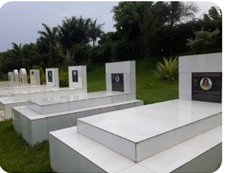
The Rwanda Land Management and Use Authority have introduced new guidelines prohibiting the construction of graves using concrete and tiles.
New land-use regulations in Rwanda have established fresh requirements for the management of cemeteries. These include a ban on constructing graves using concrete or tiles, as well as specifications regarding the required surface area for graves and the mandatory buffer distance between cemeteries and wetlands.
These provisions are contained in a document titled “Land Use Master Plans’ Zoning Regulations – Edition 2,” published in September 2026, which also outlines new standards for residential, commercial, and industrial zones, as well as infrastructure.
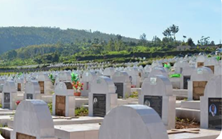
Regarding cemeteries, the document prohibits the use of concrete or tiles in the construction of graves, whether above or below ground. It also forbids the development of residential housing, commercial activities, or industrial facilities on land designated for cemeteries.
However, facilities that support cemetery management—such as restrooms, staff quarters, and places of worship—may be permitted, subject to review. The regulations also stipulate that for a cemetery located near a wetland, an environmental impact assessment must be conducted, and a buffer zone of 200 to 300 meters must be maintained.
Regarding land area, a cemetery is allocated 10 hectares for a population of between 200,000 and 250,000, while a facility for cremation is allocated two hectares for a population of 150,000. These sites may also be combined.
In addition to provisions for cemeteries, this document defines land-use categories, plot sizes, building density, and the required buffer distances between industrial facilities and residential areas.
It further stipulates that building permits for large, villa-style or mansion-type residences will not be issued until specific regulations governing them are established.
To promote organized residential development, the regulations classify land designated for housing into six categories, based on building density and the permitted type of accommodation. In certain areas, priority is given to multi-family housing rather than single-family homes. The regulations also stipulate that at least 20% of the land area of plots in certain categories must be landscaped and planted with vegetation, while 2% must be allocated for a fruit and vegetable
Regarding industrial facilities, the regulations establish mandatory buffer zones between them and residential areas. Small-scale industries are required to maintain a distance of at least 50 meters, standard industries require 500 meters, while those with the potential to cause significant pollution must be situated at least one kilometer away from human settlements.
The guidelines also prioritize bringing essential services closer to the population, stipulating that—wherever feasible—schools, health facilities, and other necessary infrastructure should be located within a 400-meter walking distance for residents.
This initiative aims to align land use with the master plans of the City of Kigali and the various districts, promote organized human settlements, and protect the environment.
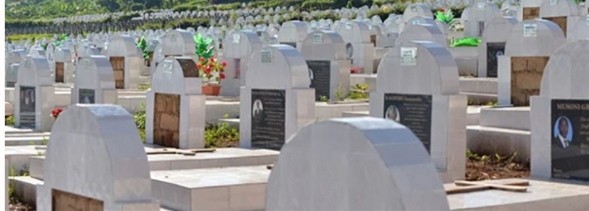
The sudden nature of death, combined with the limited financial means of many Rwandans, creates significant hardship when a loved one passes away; the costs incurred leading up to the burial often exceed what families can afford.
In some sectors or cells, there are no public cemeteries, forcing residents to seek burial sites in neighboring areas. Furthermore, even where cemeteries do exist, the associated fees are often beyond the reach of many, leading some to resort to burying their deceased on their own private land.
Residents from various sectors—particularly in rural districts such as Burera, Nyamagabe, Nyabihu, and Nyagatare—spoke with Pax Press (a network of journalists promoting peace) and explained that some families cannot afford the fees charged by cemetery owners. Paying these costs often requires selling livestock, yet families are still frequently left with outstanding debts.
A resident of Cyanika Sector in Burera District noted that there is no public cemetery in their sector. Consequently, when a death occurs, they are forced to travel to Musanze District for a burial site—where, in turn, the cemetery fees also prove to be prohibitively expensive.
He said, “It is really difficult for us to come up with the money; if you don’t own a goat or a cow, you simply cannot afford it. You might have to borrow from a savings group or a similar collective. It would be helpful if the Government intervened and negotiated with the private contractor managing the cemeteries to lower the costs—perhaps setting the price around 15,000 [Rwf]. That way, one could at least strive to raise that amount. Even if you own a single goat, you cannot get that much cash all at once; you end up in debt, struggling to pay it off while also grieving the loss of your loved one.”
Another person added, “When you lose someone, you have to push yourself to the limit to find the money for a burial plot. If you own a small piece of land, you might have to give it up; if you have livestock, you might have to sell them. Burying a loved one is truly a struggle—a battle to find the funds just to secure a place for the burial.”
Anselme Nkusi, the official in charge of burial operations at the Rusororo cemetery, disagrees with the claim that burials are prohibitively expensive. He explains that their cemetery offers different pricing tiers, ensuring that there is an option suitable for everyone. He explained, “For a citizen who arrives with documentation from the cell and sector certifying that they are indigent, we provide burial services free of charge. We prepare the burial site, conduct the interment, and then the family can depart. In the case of a standard earth burial, we dig the grave, the burial takes place, and we then fill it back in with soil. For this service—with no additional requirements—the cost is 7,500 Rwf. Then there is the concrete-lined option: we excavate the grave, construct a concrete structure, and finish it with a cement slab; the cost for this service is 180,000 Rwf.”
There is also a premium category—referred to as the ‘tiled’ option—where the grave is excavated and lined with bricks, with tiles installed on the interior. Once the burial is complete, tiles are also applied to the exterior. The cost for this is 490,000 Rwf for an adult, and 340,000 Rwf for a child.
Monique Husi, Director General for Social Development and Community Welfare at the Ministry of Local Government (MINALOC), states that the law mandates the District Council to determine the management, usage, and pricing of public cemeteries, as well as to enter into agreements with service providers (concessionaires).
She says, “As MINALOC, we are revisiting the issue of pricing—specifically where concerns have been raised—to ensure that the administration continues to look out for the citizens’ interests. In cases where fees are excessively high, we will work with the service provider to assess the residents’ financial capacity and set rates that are affordable for the people in that specific area.”
Research conducted this year by the organization Pax Press (a network of journalists promoting peace), in collaboration with 16 other non-governmental organizations, found that the cost of burial in public cemeteries ranges between 70,000 and 300,000 Rwandan francs.
Government policy stipulates that all burials must take place in public cemeteries, as these are the only designated sites for the interment of the deceased. In Rwanda, there are 1,439 cemeteries—accounting for 66.9%—while among the country’s 416 sectors, approximately 91 (representing one-quarter) lack a public cemetery.
Join Literature TV 250 on Rumble
English • Literature • Education • Stories
Click here: https://rumble.com/c/c-7949674
- Open the link
2. Log in or create a free Rumble account
3. Click FOLLOW
Or on Whatsap on the link https://chat.whatsapp.com/EsjoyIq1Ur26Zicfgr9yH7
OR OUR CHANNEL https://whatsapp.com/channel/0029VbDJMjr0G0XejxLOdh0T
Thank you for supporting Literature TV 250!
Literature TV 250 is an instructive channel dedicated to promoting English language, literature, reading, writing, storytelling, poetry, drama, and critical thinking. Its purpose is to help students, teachers, writers, and other learners improve their knowledge and skills through clear lessons, literary discussions, educational materials, and inspiring stories, while also encouraging a love of literature and lifelong learning. Click here to join this Channel on other social media