
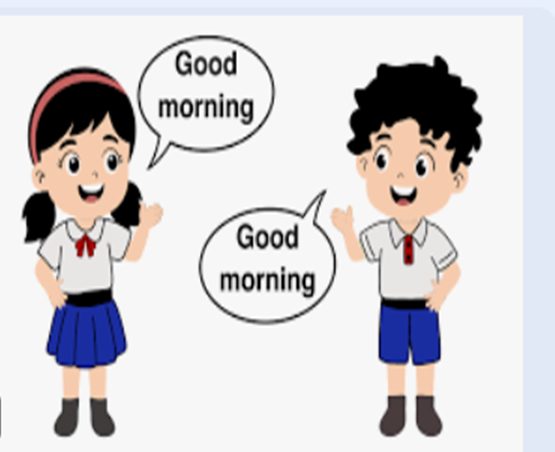
Greeting is defined as an expression of good wishes: regards. Some common ways of greeting people in English are listed as below:
Formal Greetings
Used in schools, workplaces, or with people you do not know well.
• Good morning
• Good afternoon
• Good evening
• Hello
• How do you do?
• Nice to meet you
Informal Greetings
Used with friends, classmates, or family.
• Hi
• Hey
• What’s up?
• How are you?
• How’s it going?
• Long time no see!
Time-Based Greetings
• Good morning — before noon
• Good afternoon — from noon to evening
• Good evening — in the evening
• Good night — when leaving or going to sleep
Greetings in Conversation
• “Hello, how are you?”
• “Hi, nice to see you.”
• “Hey! What’s new?”
• “Good morning, teacher.”
Greetings in Different Situations
Situation Greeting
Meeting a teacher Good morning, sir/madam
Meeting a friend Hi!
Answering the phone Hello
Meeting after a long time Long time no see!
Formal Greetings
Used in schools, workplaces, or with people you do not know well.
• Good morning
• Good afternoon
• Good evening
• Hello
• How do you do?
• Nice to meet you
Informal Greetings
Used with friends, classmates, or family.
• Hi
• Hey
• What’s up?
• How are you?
• How’s it going?
• Long time no see!
Time-Based Greetings
• Good morning — before noon
• Good afternoon — from noon to evening
• Good evening — in the evening
• Good night — when leaving or going to sleep
Greetings in Conversation
• “Hello, how are you?”
• “Hi, nice to see you.”
• “Hey! What’s new?”
• “Good morning, teacher.”
Greetings in Different Situations
Situation Greeting
Meeting a teacher Good morning, sir/madam
Meeting a friend Hi!
Answering the phone Hello
Meeting after a long time Long time no see!
Show me responses to greetings
Here are common responses to greetings in English:
Greeting Possible Responses
Hello / Hi Hello! / Hi!
How are you? I’m fine, thank you. And you?
Good morning Good morning
Good afternoon Good afternoon
Good evening Good evening
What’s up? Not much. / Nothing much.
How’s it going? It’s going well. / Pretty good.
Nice to meet you Nice to meet you too
Long time no see Yes, it’s been a while!
How do you do? How do you do?
Example Conversations
- Formal
• A: Good morning, teacher.
• B: Good morning. How are you?
• A: I’m fine, thank you. - Informal
• A: Hey!
• B: Hi! What’s up?
• A: Nothing much. - Meeting Someone New
• A: Nice to meet you.
• B: Nice to meet you too.
Polite Responses
• I’m doing well, thank you.
• Very well, thanks.
• I’m okay.
• Not bad, thanks.
Formal Greetings
Used in schools, workplaces, or with people you do not know well.
• Good morning
• Good afternoon
• Good evening
• Hello
• How do you do?
• Nice to meet you
Informal Greetings
Used with friends, classmates, or family.
• Hi
• Hey
• What’s up?
• How are you?
• How’s it going?
• Long time no see!
Time-Based Greetings
• Good morning — before noon
• Good afternoon — from noon to evening
• Good evening — in the evening
• Good night — when leaving or going to sleep
Greetings in Conversation
• “Hello, how are you?”
• “Hi, nice to see you.”
• “Hey! What’s new?”
• “Good morning, teacher.”
Greetings in Different Situations
Situation Greeting
Meeting a teacher Good morning, sir/madam
Meeting a friend Hi!
Answering the phone Hello
Meeting after a long time Long time no see!
Here are common responses to greetings in English:
Greeting Possible Responses
Hello / Hi Hello! / Hi!
How are you? I’m fine, thank you. And you?
Good morning Good morning
Good afternoon Good afternoon
Good evening Good evening
What’s up? Not much. / Nothing much.
How’s it going? It’s going well. / Pretty good.
Nice to meet you Nice to meet you too
Long time no see Yes, it’s been a while!
How do you do? How do you do?
Example Conversations - Formal
• A: Good morning, teacher.
• B: Good morning. How are you?
• A: I’m fine, thank you. - Informal
• A: Hey!
• B: Hi! What’s up?
• A: Nothing much. - Meeting Someone New
• A: Nice to meet you.
• B: Nice to meet you too.
Polite Responses
• I’m doing well, thank you.
• Very well, thanks.
• I’m okay.
• Not bad, thanks.
Show me greetings and responses for students
Greetings and Responses for Students
In the Classroom
Greeting Response
Good morning, teacher. Good morning, students.
Hello, classmates. Hello!
How are you today? I’m fine, thank you.
Welcome to class. Thank you.
Nice to see you again. Nice to see you too.
Between Students
Greeting Response
Hi! Hi!
Hey, how are you? I’m good. And you?
What’s up? Nothing much.
How was your day? It was good.
Long time no see! Yes, really!
At School
Situation Greeting Response
Meeting the principal Good morning, sir/madam. Good morning.
Entering class late Sorry I’m late. Please take your seat.
Meeting a new student Nice to meet you. Nice to meet you too.
Example Dialogues - Student and Teacher
• Student: Good afternoon, teacher.
• Teacher: Good afternoon. How are you?
• Student: I’m fine, thank you. - Two Students
• Student A: Hey, John!
• Student B: Hi! How’s school?
• Student A: It’s going well. - New Classmates
• Student A: Hello, my name is David.
• Student B: Hi David, I’m Kevin. Nice to meet you.
• Student A: Nice to meet you too.
Polite Expressions Students Use
• Please
• Thank you
• Excuse me
• Sorry
• You’re welcome
Telephone Greetings
Basic Telephone Greetings
Greeting Response
Hello Hello
Good morning Good morning
Hi, this is John speaking. Hi John
May I speak to Mary? Speaking. / One moment, please.
Formal Telephone Greetings
Used in offices, schools, or businesses.
Greeting Response
Good morning, ABC Company. How may I help you? Good morning. I would like to speak to the manager.
Hello, this is Mr. Smith speaking. Hello, sir.
May I know who is calling? My name is David.
Informal Telephone Greetings
Used with friends and family.
Greeting Response
Hey! Hi!
What’s up? Nothing much.
How are you? I’m good, thanks.
Example Telephone Conversations - Calling a Friend
• A: Hello!
• B: Hi, Kevin. How are you?
• A: I’m fine, thanks. - Calling a School
• Receptionist: Good morning, Green School. How may I help you?
• Caller: Good morning. May I speak to the head teacher?
• Receptionist: One moment, please. - Wrong Number
• A: Hello, may I speak to Sarah?
• B: Sorry, wrong number.
• A: Oh, sorry about that.
Useful Telephone Expressions
• Hold on, please.
• Please wait a moment.
• The line is busy.
• Can you hear me?
• I’ll call you back.
• Thank you for calling.
• Goodbye.
Emergency Phone Call Examples - Calling an Ambulance
Operator: Emergency services. What is your emergency?
Caller: Please help! Someone is injured.
Operator: What is your location?
Caller: We are on King Street near the market.
Operator: Is the person breathing?
Caller: Yes, but he is badly hurt.
Operator: An ambulance is on the way. Stay calm. - Calling the Police
Police: Police emergency. How may we help you?
Caller: There is a robbery near my house.
Police: What is your address?
Caller: It is 15 Lake Road.
Police: Stay inside and keep safe. Officers are coming. - Calling the Fire Department
Firefighter: Fire emergency. What happened?
Caller: My house is on fire!
Firefighter: What is your location?
Caller: 22 Palm Avenue.
Firefighter: Leave the building immediately. Help is coming. - Reporting a Road Accident
Operator: Emergency line.
Caller: There has been a car accident on the highway.
Operator: Are there injuries?
Caller: Yes, two people are hurt.
Operator: Ambulances and police are on the way.
Important Emergency Expressions
• Help!
• Please come quickly.
• There is an emergency.
• Someone is hurt.
• We need an ambulance.
• Call the police.
• There is a fire.
• Stay calm.
• Help is on the way.
Tips for Emergency Calls - Speak clearly.
- Give your exact location.
- Explain the emergency briefly.
- Stay calm.
- Follow instructions from the operator.
Emergency Numbers in Rwanda
• Police: 112
• Ambulance: 912
• Fire Brigade: 111