
A new report by the independent body that monitors the implementation of peace agreements in Africa, the Barometer of Peace Agreements in Africa (BAPA), shows that one year after the signing of the peace agreement between Rwanda and the Democratic Republic of the Congo (DRC), its implementation has reached 35%.
On June 27, 2025, the Minister of Foreign Affairs of Rwanda, Amb. Olivier Nduhungirehe, and his Congolese counterpart, Thérèse Wagner Kayikwamba, signed an agreement signed in Washington, aimed at ending the long-standing conflict in eastern DRC.
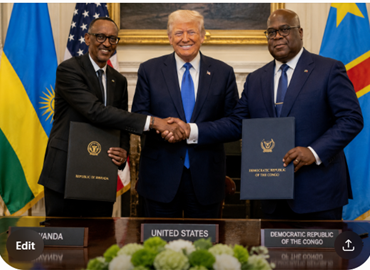
Also on December 4, 2025 in Washington, President Kagame and Felix Tshisekedi, together with US President Donald Trump, signed another agreement called the Washington Accords aimed at ending the 30-year war in eastern Congo.
All these agreements were aimed at building trust between the two parties and establishing a sustainable mechanism for peace and security in the region.
The Africa Report reported that the report by BAPA shows that there has been progress in establishing cooperation structures and initiating activities stipulated in the agreements, but it emphasizes that many of them are still in the early stages of implementation, where they have not yet been completed.
Of the 30 tasks listed in the agreements, some have begun to be implemented while others have not yet been implemented.

The report shows that of the 30 tasks, only three have been successfully completed while 19 are still underway and 8 of them have not been implemented at all.
BAPA says that although there is significant progress compared to the first months after the signing of the agreements, the pace is still low compared to expectations.
Regarding the status of each country in implementing its obligations, the BAPA report shows that Congo has implemented 31.7% of its commitments, while Rwanda has reached 30.6%.
This is while international mediators including the United States, Qatar and the African Union have reached 53.5%.
The report shows that both parties have expressed their willingness to continue the talks and fulfill their commitments, but that there are important issues that require close cooperation, including security issues, eliminating armed groups, building confidence between the two parties and establishing a permanent mechanism to monitor the implementation of the agreement.
BAPA shows that since the signing of the agreement, fighting in eastern Congo has continued between the AFC/M23 and the Congolese government forces (FARDC).
The Chief Author of the BAPA report, Dr. Roger-Claude Liwanga says that what has been done has focused on the leadership and the establishment of cooperation structures, but the main security issue remains.
Liwanga explains that the biggest problem with the agreement is that it does not clearly define how the FDLR group will be destroyed.
He said: “That is a big problem. After a few months, the DRC can say that it has destroyed the FDLR, and Rwanda can say that it has not been done because the two sides have not agreed on the criteria to be used.”
US sanctions on RDF one of the reasons for the delay in this agreement
On March 2, the US Treasury Department announced sanctions on the Rwandan Armed Forces (RDF) and four military officers, accusing them of supporting the M23 movement in the long-running war in eastern DRC and violating Washington’s peace agreement.
In this report, BAPA Liwanga reveals that things started to go wrong after the US imposed sanctions on some Rwandan military leaders and those suspected of involvement in the trade in precious minerals from Congo.
He said: “The parties knew that there were no sanctions or other pressure measures planned. But since these sanctions were imposed, things started to go wrong.”
Also on June 25, 2026, the US, through the Office of Foreign Assets Control (OFAC) of the Treasury Department, imposed sanctions on the Rwandan company ‘Gasabo Gold Refinery Ltd’ and its management
Rwanda has shown that these sanctions are biased and says that imposing sanctions on the RDF was not prudent.
Rwanda and the DRC have agreed on key joint projects, including cooperation in power generation, building infrastructure to facilitate trade, mining and processing of precious minerals, preserving national parks and tourism activities, and developing the health sector.