
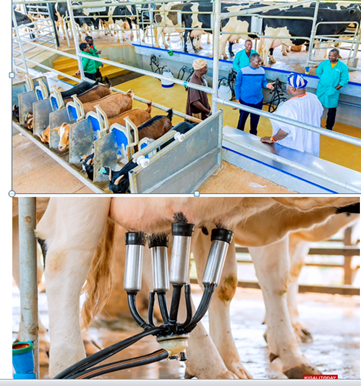
In the past, when our cows were going to be milked, they would release their udders to let them urinate, but at that time, a cow would milk three, four, or five liters.
Today, cows milk up to twenty liters, and some even more, so it would be difficult to milk two cows.
The Rwanda Agricultural Research Institute (RICA), located in Bugesera District, is now teaching Rwandans the technology for milking cows using a special machine.
To begin, there are basic hygiene measures and checking the quality of the milk that is going to be milked.
Dr. Severin Munyampuhwe, a specialist in animal husbandry and milk processing technology at RICA, says that before milking, the milker takes a bucket, puts in it lukewarm water, soap, and a cloth.
Munyampuhwe says, “A wet cloth is what we use to wash the udders. It is folded into four parts. We wash each part of the udder so that if there is a udder with dirt, it does not spread to the other udders.” “After washing, we measure to make sure that the cow we are going to milk is not sick. We measure the dirt that is visible to the eye (Clinical Mastitis). We have a cup called a strip cup, which has filters in it, where we suck each udder through these filters. When a cow is sick, the milk curdles, it does not pass through, and that is how we know that the cow is sick.”
After this, they take a special machine, (Milking unit) and attach a nipple to each udder and squeeze the cow until it is milked.
For a Rwandan who is familiar with this technology, you might think that these things are not good for the cow, but that is not the case. First of all, the water used to wash the cow is lukewarm, since the calf’s mouth is said to be the same temperature as lukewarm water.
These machines also use a method called vacuum, where the machine sucks and squeezes the udder, which is exactly like when the calf is milking, and the milk passes through the nipples until it reaches the milking trough.
It is a method that speeds up the milking process compared to manual milking, as it can take between 5-7 minutes for a cow that drinks 20 liters. Milking a cow like this can take 20 minutes for manual milkers.
In the meantime, any farmer with a pasture can buy this machine, so that he can milk his cows in a short time, and hope to have them milked now. One RICA machine has the capacity to milk four cows at a time.
However, there are also those that can milk two cows at a time, which are at a moderate price for the farmer, because they do not reach a million Rwandan francs.
In RICA, they have 37 cows that milk 840 liters per day, where a cow can milk at least 23 liters.
In Kinyarwanda, when a cow is milked, it is protected by using lime, thus protecting it from diseases. It is in the RICA system, there is also a special medicine that is used when they are milked, to preserve the mother.
Rwanda: According to research, some of the journalists’s Salary is 17% less than 100,000 Rwfs
Cattle were independently domesticated from the aurochs, a wild bovine species, in the vicinity of the current countries of Turkey and Pakistan ∼10,000 years ago. Cattle have since spread with humans across the world, including to regions where these two distinct lineages have hybridized. The Indian aurochs is thought to have been domesticated 10,000–8,000 years ago. Aurochs fossils found at the Neolithic site of Mehrgarh in Pakistan are dated to around 8,000 years BP and represent some of the earliest evidence for its domestication on the Indian subcontinent. It evolved through Old English eventually transforming into the modern English “cow”.

The cows before the arrival of milking using machines
Its historical and etymological evolution highlights distinct shifts:
Proto-Indo-European (PIE): which referred generally to bovine animals? This ancient root is why similar sounding words exist across many languages.