
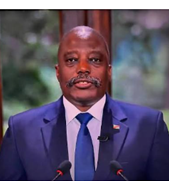
Joseph Kabila, the former President of the Democratic Republic of the Congo (DRC), has accused the administration of Félix Tshisekedi of supplying weapons to the FDLR and integrating the group into the military. He stated that these actions have reversed the progress previously made in countering armed groups in the eastern part of the country.
Kabila—who recently assumed leadership of the *Front pour la Refondation de la Nation* (FRN)—also criticized how Rwanda is leveraged within DRC politics, noting that attacking Rwanda has effectively become a cornerstone of the Kinshasa administration’s political agenda. He made these remarks during an exclusive interview with CTGL (Conspiracy Tracker Great Lakes), conducted by researcher and author Dr. Bojana Coulibaly and journalist Teddy Mazinamu. This comes at a time when the relationship between Kabila and Tshisekedi continues to deteriorate; the current DRC President recently accused Kabila of acting as a tool for President Paul Kagame in the conflict unfolding in the country’s east. Kabila accused Kinshasa of collaborating with the FDLR.
Kabila stated that the issue of insecurity in the eastern DRC cannot be understood without examining the region’s history—specifically, the events that followed the 1994 Genocide against the Tutsi in Rwanda. He said, “In 1994, the Genocide took place, and some of those who participated in it fled to Congo, while others went to Tanzania, alongside other fleeing civilians. Those who took part in the Genocide brought that ideology with them.” He noted that, even 32 years later, this ideology remains present in the region, and that his administration had made the decision to combat it—including through the use of military force.
Kabila explained that, starting in 2006, the DRC collaborated with neighboring countries and the United Nations to counter the FDLR, the ADF, and other armed groups—though he acknowledged that these efforts did not achieve 100% success. He stated that this progress was reversed after he left power in 2019, accusing his successor’s administration of assisting the very groups it was supposed to be fighting. He stated, “What is happening now is that these groups—including the FDLR—are being openly empowered, openly supplied with weapons, and even openly integrated into the military and other security organs.”
The FDLR Issue Concerns the DRC
A UN experts’ report released in 2026 indicated that DRC forces collaborate with the FDLR.Kabila stated that the FDLR issue must be resolved by the DRC itself, rather than being framed solely as Rwanda’s problem. He said, “If the FDLR issue exists within Congo, then Congo must build the capacity to resolve it. Whatever methods are employed, Congo must possess that capacity.”
He further noted that the challenge goes beyond merely fighting the group’s combatants; it also involves combating the ideology of genocide to prevent it from spreading further or being used to recruit new followers. He added, “You cannot rely on guns alone. You must also engage in dialogue and education, ensuring that those who harbor this ideology are not given the space or opportunity to continue recruiting followers.”
Kabila on Allegations of Working for Rwanda
Kabila also addressed accusations from Kinshasa linking him to Rwanda—particularly following his assumption of leadership within the FRN, a coalition that includes leaders from the AFC/M23 group. On October 26, 2026, while speaking to members of his political coalition, the *Union Sacrée de la Nation*, President Tshisekedi alleged that President Kagame had urged Kabila to come out into the open and assume leadership of the armed groups fighting against the Kinshasa government.
In response to accusations that he is working for Rwanda and seeking to partition the DRC, Kabila pointed to the history of various groups that have opposed the Kinshasa government, noting that these groups existed even before Rwanda became involved in the DRC’s conflicts.
He reflected on the struggle against Mobutu’s regime, the uprisings of the 1960s, and other groups that opposed the ruling authorities in the years that followed.
He remarked, “At that time, Rwanda was not involved in these issues.”
Kabila sought to demonstrate that the opposition to the Kinshasa government did not originate because of Rwanda; rather, such conflicts have historically occurred in the DRC whenever citizens and political groups became dissatisfied with the regime.
Kabila stated, “Insulting Rwanda has become a political policy.”
One of the points Kabila strongly criticized is the way he claims the Tshisekedi administration employs hatred and division in its governance of the country.
He noted that, currently in the DRC, anyone who cannot bring themselves to insult Rwanda, Kabila, or the people from the eastern part of the country risks being perceived as an opponent of the government.
He said, “What has happened today is that this has turned into an officially sanctioned ideology—a line that everyone is expected to follow. If you cannot insult Rwanda, Kabila, or anyone hailing from the eastern region, you face criticism.” He added that the FRN intends to combat hate speech and divisive rhetoric within the territories under its control, as he views these as significant obstacles to the unity of the Congolese people. Kabila also accused the Tshisekedi administration of utilizing security institutions in a manner based on ethnicity and regional origin, stating that this has contributed to the country’s regression into problems that had previously afflicted it.
He called for the withdrawal of Burundian troops.
Regarding the issue of foreign forces, Kabila noted that in 2019, when he left office, there were no foreign troops on DRC soil.
He specifically addressed the presence of Burundian forces, warning that their presence in the DRC could increase the risk of the conflict expanding to other countries in the region.
He recalled that during his tenure, the DRC reached peace agreements with Rwanda and Uganda, which facilitated the withdrawal of foreign troops from the country.
He stated that the FCC currently supports the withdrawal of all foreign forces from the DRC—regardless of the reasons for their initial deployment—though the modalities and timeline for such a withdrawal would need to be negotiated. Listen to this song
Kabila emphasized that the issue of the FDLR and other armed groups can be resolved, but that it requires political will, the strengthening of security institutions, and efforts to combat ideologies of hatred and division. He stated, “The vision we have for Congo and the region goes beyond the issue of the FDLR. And it is not just the FDLR; there are also the ADF and other groups.” It must be uprooted, along with its ideology, and the Congolese people must be taught that the ideology of genocide does not build a nation.