
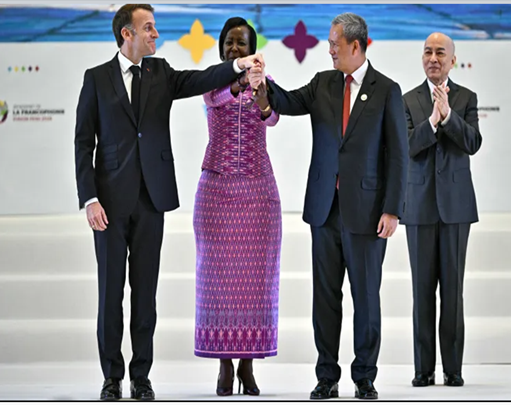
The one-year extension of Louise Mushikiwabo’s leadership of the International Organisation of La Francophonie (OIF) means she will continue to lead the organization until November 2027, at which point the position will be filled through an election.
You can learn more about other websites that work like google adsense by clicking this link
This one-year extension for the organization’s leadership serves as a transitional period, approved by the Heads of State and Government of OIF member countries during their 20th summit in Phnom Penh, Cambodia, on November 16, 2026. Masaka Kids
The primary reason for this decision is that OIF member states were unable to reach a consensus on a candidate for the next four-year term. Four candidates had been vying for the position: Rwandan Louise Mushikiwabo, Romanian Dacian Cioloș, Mauritanian Coumba Bâ, and Congolese Juliana Lumumba.
The 53 member states with voting rights opted to postpone the election of a new leader to allow time to find a candidate who could secure broad consensus.
Although Mushikiwabo will continue to lead the OIF for an additional one-year term, Rwanda has committed not to field a candidate for the position again after this period.
This one-year extension will be used to identify a successor and to resolve the issues that prevented member states from reaching a consensus.
Mushikiwabo will continue her existing duties, including overseeing the reform of the organization’s operations.
In diplomatic terms, this represents a partial victory, as Mushikiwabo has retained her position without being defeated in an election or removed from office. However, it is not a complete victory, given that she did not secure the four-year third term she was seeking, and Rwanda will not put forward a candidate for the role in the future.
Mushikiwabo has framed this decision as a victory for Africa, noting the continent’s significant role within the OIF.
International political analysts suggest that the postponement of the election indicates that the OIF has reached a critical point of decline.
In an interview with Kigali Today, Aloys Mutabingwa—a lawyer and analyst of international politics—stated that it is regrettable that two countries have obstructed the election process, preventing it from taking place as originally scheduled.
He remarked, “Whether it concerns the election itself or the established, legally-sanctioned procedure, these two countries have effectively refused to cooperate. Ordinarily, in the absence of a consensus, a vote would be held based on a simple majority. However, it should be noted that the process for selecting the Secretary-General was designed with an extra degree of caution, specifically to safeguard the unity of the organization’s member states.”
By opting against a simple-majority voting system, the organization has ensured that no member state is left with reservations regarding the legitimacy or conduct of the elected Secretary-General.
Mutabingwa states, “It was clear that Louise Mushikiwabo could have won, but she would have spent this third term under significant pressure from those who did not vote for her. Furthermore, there was the threat from the DRC, which indicated it would withdraw if she were elected. Macron, for his part, likely viewed a potential withdrawal by the DRC—given the large number of French speakers in that country—as a collapse of the organization.”
The OIF has already been destabilized.
Mutabingwa notes, “There is no doubt that this has happened; the task now, during this extended term, is to mitigate the severity of that destabilization. I am not even certain that this will be possible, because the fundamental problem is that in a sphere requiring diplomacy, some countries prefer coercion and force—specifically the DRC and France. This is a source of concern for Asian member states—a sentiment I share—who ask: why should we conflate things that ought to remain separate?”
These countries argue that bilateral disputes between individual nations should not be allowed to permeate the entire organization; if this chaotic situation persists, it could lead some member states to withdraw from the OIF.
Mutabingwa states, “Those who wish to avoid chaos may choose to temporarily suspend their membership. It is worth recalling that Rwanda’s eventual assumption of the leadership of this organization was intended to restore understanding and mend a relationship that had been severely strained for a long time—ever since the 1994 Genocide against the Tutsi. This is not merely a matter left to the whims of France or Canada.”
It is understood that France sought to demonstrate a shift in its approach—moving away from a history of confrontation with the Rwandan government—given France’s own role in the Genocide that took place in Rwanda, an event that did not unfold exactly as its architects had intended.Furthermore, analysts observe that the OIF needs Rwanda just as much as Rwanda needs the OIF; it is a mutually beneficial relationship. Rwanda should be accorded the same rights as other member states, ensuring that no country receives preferential treatment at the expense of others. A conflict between two member states has escalated into a broader issue within the organization. Factions and groups have emerged, attempting to shield their respective allies. France is the primary actor that contributed to this situation. My concern is not so much the conduct of the DRC, but rather the fact that a party—which ought to have remained neutral—has chosen to take sides.
It is suggested that France failed to handle this matter with sufficient care; given that such organizations are founded on diplomacy, the situation could easily deteriorate further. Rwanda’s decision not to seek re-election—a move stemming from its dissatisfaction with this conduct—could even lead to its withdrawal from the organization altogether, as it pursues other paths.