
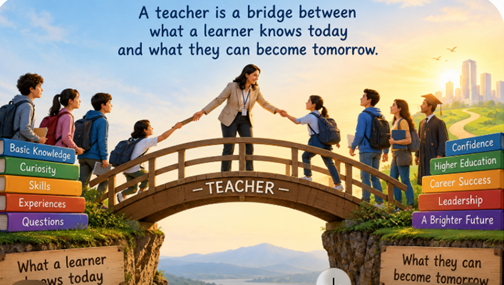
On 05 October every year, it is a day dedicated to all the teachers’ national wide. The teacher is a light that shines not only in the classroom but also, outside the society can greet it as they make a flashback when they were still at school bench. A teacher is a person whose job is to teach, guide, and educate learners by helping them gain knowledge, skills, values, and good attitudes. Others will say that a teacher is a bridge between what a learner knows today and what they can become tomorrow.
Instructor : He teaches subjects and explains difficult concepts by using epistemology.
Guide: He helps learners make good academic and personal decisions.
Role model: He demonstrates good behavior, discipline, honesty, and responsibility.
Motivator: He encourages learners to work hard and believe in themselves.
Counselor: He listens to learners and helps them deal with challenges.
Evaluator: He assesses learners’ progress through tests, assignments, and examinations.
Disciplinarian: He promotes good behavior and a positive learning environment.
Parent figure at school: He provides care and protection while learners are under the teacher’s supervision.
A teacher is not only a person who delivers lessons; a teacher helps shape the knowledge, character, behavior, and future of learners. Even though he may face come challenges in the course of teaching and guiding learners, he will reamain constant and strong. Celebrating, the teachers today are not limited to saying the number of questions like:
Large classes: Teaching many learners at once makes it difficult to give individual attention.
Lack of teaching materials: Some schools may not have enough textbooks, computers, laboratories, or other learning resources.
Poor learner discipline: Disobedience, noise, lateness, bullying, and other forms of misconduct can make teaching difficult.
Different learning abilities: Learners have different levels of understanding, making it challenging to teach everyone at the same pace.
Heavy workload:Teachers have to prepare lessons, mark exercises, write reports, attend meetings, and perform other duties.
Low motivation: Poor working conditions, inadequate salaries, or lack of recognition can reduce a teacher’s motivation.
Pressure from parents and school authorities:Teachers may be expected to produce excellent academic results despite limited resources.
Limited time:There may be too much content to cover within the available school time.
Technological challenges: Lack of internet, electricity, devices, or digital skills can make modern teaching difficult.
Emotional stress: Dealing with difficult learners, parents, colleagues, and administrative demands can cause stress.
Learners’ personal problems: Poverty, family conflicts, illness, and other difficulties can affect learners’ performance and require teachers’ attention.
Assessment pressure:Teachers may be under pressure to ensure learners perform well in examinations.
Lack of parental cooperation: Some parents may not support their children’s education or communicate effectively with teachers.
Changing curriculum:Teachers sometimes have to adapt quickly to new curricula, teaching methods, and educational policies.
Safety and security concerns: Teachers may sometimes work in environments where their personal safety or that of learners is a concern.
Despite these challenges, a good teacher remains patient, committed, creative, responsible, and caring. Teachers play an important role in shaping learners’ academic success, character, and future
A teacher is different from many other workers because the teacher’s main responsibility is to educate, guide, and shape the lives of learners, rather than simply producing goods or providing a service.
| Teacher | Other Workers |
| 1. Teaches knowledge and skills. | Many provide goods or specific services. |
| 2. Shapes learners’ character and behaviour. | Their work may not directly involve character formation. |
| 3. Works mainly with learners. | They may work with customers, machines, documents, or products. |
| 4. Acts as a role model for learners. | Being a role model may not be a central part of their job. |
| 5. Guides and counsels learners. | Other workers usually focus more on their specific professional duties. |
| 6. Assesses learners’ progress. | Other workers may evaluate products, services, or business results instead. |
| 7. Often works beyond classroom hours by preparing lessons and marking work. | Working hours and duties vary according to the profession. |
| 8. Has a long-term influence on learners’ lives. | Many workers’ responsibilities are more directly connected to immediate products or services. |
| 9. Deals with learners of different abilities, backgrounds, and behaviours. | Other workers may deal mainly with customers, colleagues, or equipment. |
| 10. Helps prepare the next generation of professionals and leaders. | Other workers generally practise their own professions. |
Other workers may build houses, sell goods, treat patients, drive vehicles, or provide different services, while a teacher helps build the people who will become doctors, engineers, farmers, leaders, businesspeople, and other professionals.
Therefore, teaching is not only a job; it is also a responsibility to shape the future of society.
A teacher in Rwanda is an educator who goes beyond traditional classroom teaching. The modern Rwandan teacher is expected to use technology, learner-centred methods, creativity, critical thinking, and practical skills to prepare learners for a changing world.
Technology user: He uses computers, smartphones, projectors, the internet, and digital learning materials where available.
Learner-centred: He encourages students to participate, ask questions, discuss, research, and solve problems instead of only listening to the teacher.
Good communicator: He communicates effectively with learners, parents, colleagues, and school authorities.
Role model: Demonstrates discipline, honesty, respect, punctuality, and responsibility.
Creative and innovative: Finds new ways of making lessons interesting and understandable.
Critical thinker: Encourages learners to analyse information rather than simply memorising it.
Inclusive: Gives attention to learners with different abilities, backgrounds, and learning needs.
Lifelong learner: Continually improves professional knowledge and teaching skills.
Career guide: Helps learners identify their talents and make appropriate educational and career choices.
Community contributor:Helps learners understand their responsibilities to their families, communities, Rwanda, and the wider world.
The modern teacher may also face large classes, limited resources; pressure to achieve good examination results, technological challenges, curriculum changes, administrative duties, and learners with different educational and social needs.
A teacher in today’s Rwanda is therefore not simply a person who stands in front of a class and gives lessons. He or she is a teacher, guide, counselor, role model, technology user, researcher, innovator, and mentor. The ultimate responsibility is to help produce knowledgeable, skilled, disciplined, creative, and responsible citizens who can contribute to Rwanda’s development.
Happy Teacher’s day ad enjoy the party
Join Literature TV 250 on Rumble
English • Literature • Education • Stories
Click here: https://rumble.com/c/c-7949674
1. Open the link
2. Log in or create a free Rumble account
3. Click FOLLOW
Thank you for supporting Literature TV 250!
Literature TV 250 is an instructive channel dedicated to promoting English language, literature, reading, writing, storytelling, poetry, drama, and critical thinking. Its purpose is to help students, teachers, writers, and other learners improve their knowledge and skills through clear lessons, literary discussions, educational materials, and inspiring stories, while also encouraging a love of literature and lifelong learning. Click here to join this Channel on other social media https://rumble.com/c/c-7949674TO
Thank you for supporting Literature TV 250!