
In recent months, two African nations—Zambia and the Central African Republic (CAR)—announced plans to abolish the death penalty.
Overall, 22 member states of the African Union (AU) have abolished the death penalty for all crimes. As of 2021, only four AU member states remained retentionist: Botswana, Egypt, Somalia, and South Sudan.
Seventeen African countries are considered “de facto abolitionist,” meaning they have not carried out any executions in the past 10 years.
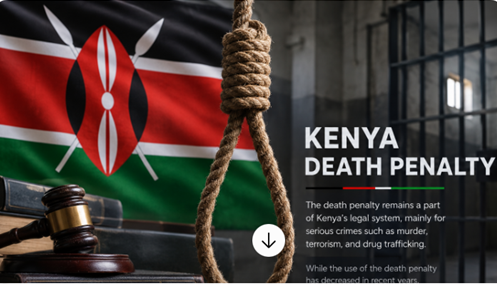
Kenya is among these; it retains the death penalty—specifically by hanging—a legacy of British colonial rule. This sentence can be imposed for murder, other capital offenses, robbery (even when it does not result in death), and treason.
This includes the case of Hezekiya Ochuka and Pancras Oteyo Okumu, who were executed for their roles in an unsuccessful attempt to overthrow President Daniel arap Moi in 1982.
Based on research and legal expertise, we believe that Kenya retains the death penalty due to inertia, convenience, and a path of least resistance, rather than on the basis of concrete, evidence-based reasoning.
Research indicates that the Kenyan public’s knowledge regarding the death penalty is limited. Only 66% of the population is aware that the country still maintains the death penalty, and just 21% know that no executions have taken place in the last 35 years. Over the years, more than 100 individuals have been sentenced to death, primarily for murder or violent robbery.
Another factor contributing to government inertia is the practice of mass commutations. In 2009, under the administration of President Mwai Kibaki, the death sentences of 4,000 prisoners were commuted; in 2016, President Uhuru Kenyatta commuted the sentences of another 2,747 individuals.
However, executions could resume as long as the laws remain on the statute books. This is why experts argue that it is essential to push for the abolition of the death penalty—a move that would provide peace of mind to those currently living under the shadow of death. In fact, international jurisprudence indicates that a prolonged period awaiting execution—often referred to as “death row phenomenon”—constitutes a cruel, inhumane, or degrading punishment.
Recent research conducted by the University of Oxford and the Kenya National Commission on Human Rights (KNCHR) shows that public opinion in Kenya is shifting toward supporting the abolition of the death penalty, and that there is no significant public opposition to such a move. Therefore, alongside legal or legislative reforms, there must be engagement from civil society and grassroots initiatives to involve the public in this process.
Measures have been introduced to limit the scope and application of the death penalty. In 2017, the Supreme Court of Kenya ruled that the mandatory death sentence for murder is unconstitutional. This shifted the approach toward a more discretionary assessment of whether the death penalty should be imposed. While the death penalty remains a possible sentence, it is no longer the only option.
Courts continue to hand down death sentences. At the end of 2021, there were 601 individuals on death row, with 14 new death sentences imposed that year. Governments that persist in using the death penalty often claim that their citizens support it. Kenyan authorities are no exception. In 2007 and 2015, the Kenyan Parliament considered the abolition of the death penalty (through private member’s bills, which were ultimately rejected by the legislature).
Public opinion is not an obstacle to abolition.
Our research team conducted a study on a sample of 1,672 Kenyans. We found that a narrow majority (51 percent) supported retaining the death penalty. Just under a third were strongly in favor of its retention.
This level of support is lower than that observed in other African countries that are abolitionist *de facto*. For instance, our research in Zimbabwe indicated that 61 percent of the population supported retaining the death penalty.
The study also revealed that, in Kenya, support for the death penalty in specific (concrete) scenarios was lower than the general level of support. For instance, the figure dropped to 32 percent regarding robbery resulting in death, and to 27 percent for murder.
Most citizens who initially supported retaining the death penalty stated that they would accept its abolition if it became official Kenyan government policy. Similarly, nearly all respondents indicated that they would fully support a parliamentary move to abolish the death penalty.
Historically, there have been various paths toward abolishing this punishment in Africa.
In Rwanda, the death penalty was abolished following a period of oppressive rule. In Sierra Leone, the president spearheaded a campaign that led to a parliamentary vote. In South Africa, the post-apartheid constitution paved the way for the judiciary to outlaw the death penalty, based on the right not to be subjected to treatment that is “cruel, inhuman, or degrading.”
The strategy proposed by the Kenyan respondents involves amending the penal code. However, it was also suggested that a multi-pronged approach—involving the judiciary, religious institutions, and the president—would be necessary. Another avenue would be to lobby Kenya to sign international treaties regarding the abolition of the death penalty