
The First Triumvirate
The First Triumvirate was an informal political alliance formed in 60 BCE in ancient Rome by three powerful men:
- Julius Caesar
- Pompey the Great
- Marcus Licinius Crassus
The word triumvirate means “rule by three men.”
Why Was It Formed?
The three leaders joined together because each wanted political advantages:
- Julius Caesar wanted support to become consul (ambassador) and gain military command.
- Pompey wanted land and rewards for his soldiers.
- Crassus wanted policies that would benefit his financial interests and supporters.
By cooperating, they could dominate Roman politics and overcome opposition from the Senate.
Achievements
- Caesar became Consul of Rome in 59 BCE.
- Pompey’s veterans (troupers) received land.
- Crassus gained favorable financial legislation.
- Caesar later received command in Gaul, where he won major military victories.
Decline of the First Triumvirate
The alliance weakened because:
- Crassus was killed in 53 BCE during the Battle of Carrhae.
- Pompey and Caesar became rivals.
- Pompey aligned himself with the Roman Senate.
The Second Triumvirate
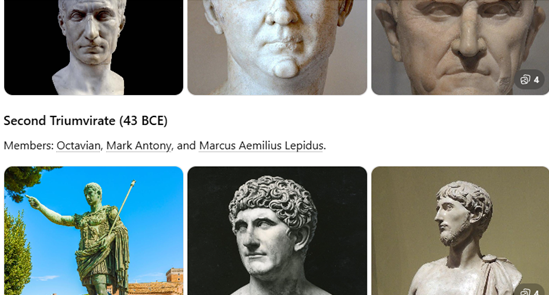
The Second Triumvirate was a political alliance in ancient Rome formed in 43 BC by:
- Octavius
- Mark Antony
- Marcus Aemilius Lepidus
Unlike the First Triumvirate, the Second Triumvirate was a legal and official governing body recognized by Roman law.
Reasons for Its Formation
- To avenge the assassination of Julius Caesar in 44 BC.
- To defeat Caesar’s assassins, especially Marcus Junius Brutus and Gaius Cassius Longinus.
- To restore order and control Rome after political instability.
Major Achievements
- The triumvirs defeated Brutus and Cassius at the Battle of Philippi in 42 BC.
- They divided the Roman territories among themselves:
- Antony controlled the East.
- Octavius controlled the West.
- Lepidus controlled Africa.
Decline and fall
- Lepidus gradually lost power and was forced into retirement.
- Rivalry grew between Antony and Octavius.
- In 31 BC, Octavius defeated Antony and Cleopatra at the Battle of Actium.
Significance
- The Second Triumvirate ended the Roman Republic’s final resistance.
- It paved the way for Octavian to become Augustus, the first emperor of Rome.
- It marked the transition from the Roman Republic to the Roman Empire.
Major Themes in Julius Caesar
- Power and Ambition
- Fate versus Free Will
- .3. Loyalty and Friendship
- Honor and Integrity
- Betrayal
- Appearance versus Reality
- Jealousy
- 6. Persuasion and Rhetoric
- Tyranny
- Revenge
7. Leadership and Governance
9. Conflict and Civil War
10. Pride and Overconfidence
Sample Answer:
Three important themes in Julius Caesar are
- Ambition Loyalty Betrayal
Ambition is seen in Caesar’s rise to power and the fear that he may become a tyrant.
Loyalty is shown through Brutus’s struggle between his friendship with Caesar and his duty to Rome. Betrayal occurs when Brutus and the conspirators assassinate Caesar despite being his trusted friends. These themes help Shakespeare explore the complexities of politics and human relationships.
The Feast of Lupercalia
The Feast of Lupercalia was an ancient Roman festival celebrated every year on February 15.
It was associated with
- Fertility,
Purification,
- The coming of spring.
Importance of the Feast of Lupercalia in the Play
- Introduces Julius Caesar’s Power
- Reveals Caesar’s Ambition
- Introduces the Main Conflict
- Highlights Character Traits
- Symbolizes Fertility
Key Events During the Feast
- Caesar arrives with his followers.
- Antony participates in the ceremonial race.
- The Soothsayer warns Caesar about the Ides of March.
- Cassius starts persuading Brutus to oppose Caesar.
- Antony offers Caesar the crown three times.
- Caesar refuses the crown and later suffers a public fit.
Examination Question
Q: Why is the Feast of Lupercalia important in Julius Caesar?
Answer:
The Feast of Lupercalia is important because it introduces the major characters, reveals Caesar’s increasing power and possible ambition, foreshadows his assassination through the Soothsayer’s warning, and begins the political conflict that leads to the conspiracy against him
The Ides of March
The Ides of March refers to March 15 in the ancient Roman calendar. It is best known as the day when Julius Caesar was assassinated in 44 BCE.
Meaning of “Ides”
In the Roman calendar:
- The Kalends were the first day of the month.
- The Nones fell on the 5th or 7th day.
- The Ides fell on the 13th or 15th day.
For March, May, July, and October, the Ides occurred on the 15th day.
The Assassination of Julius Caesar
On March 15, 44 BCE, a group of Roman senators led by Marcus Junius Brutus and Gaius Cassius Longinus assassinated Julius Caesar in the Roman Senate.
The conspirators believed Caesar had become too powerful and feared that he intended to make himself king, threatening the Roman Republic.
In Shakespeare’s Julius Caesar
In Julius Caesar, a soothsayer warns Caesar:
“Beware the Ides of March.”
This warning foreshadows Caesar’s death. Caesar initially ignores the prophecy and attends the Senate meeting, where he is murdered by the conspirators.
Significance
The Ides of March is significant because:
- It marks the assassination of Julius Caesar.
- It symbolizes betrayal and political conspiracy.
- It contributed to the fall of the Roman Republic and the rise of the Roman Empire.
- It is one of the most famous dates in world history and literature.
Examination Question
Q: What is the significance of the Ides of March in Shakespeare’s Julius Caesar?
A: The Ides of March is the day on which Julius Caesar is assassinated despite being warned by a soothsayer. It symbolizes fate, ignored warnings, betrayal, and the political conflict that leads to the collapse of the Roman Republic.
You may also revise 50 multiple-choice questions (MCQs) with answers on White Hands by Jane Katjavivi. as you are preparing for exams in literature